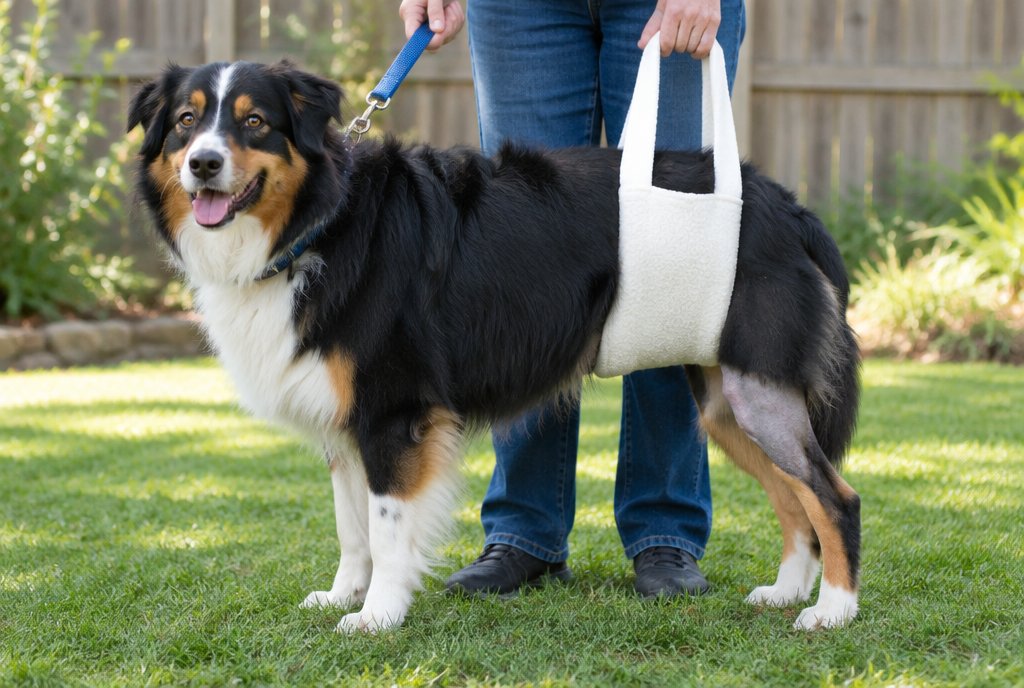
TPLO surgery recovery in a large dog takes about 10 to 12 weeks. That is how long the bone needs to heal in its new position, and it is the number that matters most. Your dog will look and feel much better long before then, which is exactly what makes the first few weeks so important to get right.
The pattern Dr. Kunal sees again and again is that the surgery goes well, the dog starts feeling good by the end of week one, and the real work becomes holding them back. This guide covers what to expect at each stage, what is normal, what is not, and how to keep a big, strong dog safe while their leg heals.
How long does TPLO recovery take in large dogs?
Full recovery takes around 10 to 12 weeks in a mature large dog. TPLO involves cutting the bone, rotating it, and holding it in place with a plate and screws, so the timeline is set by bone healing rather than by how your dog is behaving.
Here are the milestones owners can expect:
- Day 1: your dog may not put weight on the leg when they walk out of the clinic. This is completely normal.
- Weeks 1 to 2: most dogs start toe touching and then bearing weight on the operated leg.
- Week 4: you may notice only slight tenderness.
- Week 8: most dogs look completely normal. This is also when we recommend post-surgical x-rays.
- Weeks 10 to 12: bone healing is usually complete, and once x-rays confirm it, your dog can go back to off lead activity.
“By week eight, you will not be able to tell that the patient has had surgery. Your challenge is going to be to hold them back.” Dr Kunal
The TPLO recovery timeline week by week
Weeks 0 to 2 to 3: strict confinement. Your dog stays in a crate or a small room. They come out on a short lead only to go to the toilet, then go straight back in.
Weeks 3 to 4: slow return to function begins. Start with about five minutes of on lead walking in the morning and five minutes in the evening, on your normal route. No pulling, no running, and no off lead time.
Weeks 4 to 8: build up by roughly five minutes each week. By week four you should be at about 10 minutes twice daily. Keep increasing gradually.
Weeks 8 to 12: keep building at the same rate. By about week 12 most dogs are back to a normal walk, roughly 30 to 40 minutes morning and evening on the lead. Off lead running waits until the x-rays are reviewed and we give the all clear.
A common mistake is confining a dog strictly for six weeks and then taking them on a half hour walk the next day. That does not work. The increase has to be gradual and steady, week on week.


What happens at the eight week check up?
Your dog spends about half a day with us. We admit them to hospital, give them a sedative, and take two x-rays of the operated leg. Once the images are taken we reverse the sedation, your dog wakes up, and they go home the same day.
The x-rays are then sent to the surgeons, who assess how the bone is coming together and whether there are any signs of infection or a problem with the implants. A good result shows the bone healing in its new position with no implant problems and no infection. Once the surgeons have reviewed the images, we have a clear picture of how the recovery is going and what to expect from there.
If the bone has not fully healed at eight weeks, that is not a crisis. The surgeon will usually recommend staying on restricted, on lead activity until healing is complete, and we recheck from there.
Why do large dogs need an e-collar after TPLO surgery?
Because the knee is one of the easiest places for a dog to reach, and licking the incision is the fastest route to an infection. Any dog can turn around and get straight to the surgical site.
This matters more than it might sound. An infection that tracks deep into the wound, into the joint, and around the plate and screws is a very difficult problem to treat and a long recovery from there. An e-collar, a bandage, a body suit, or a combination of these keeps that from happening while the incision seals.
How long should the e-collar stay on?

The skin incision usually heals in about 10 to 14 days, so plan on an e-collar or a bandage for that full period.
The rule we give owners is simple. The collar goes on whenever your dog is not directly supervised. That means overnight and any time you leave the house. You can take it off while you are sitting with them, as long as you are actually watching and stopping any licking.
Not every dog needs the collar itself. Some could not be bothered with the wound and do perfectly well with a bandage alone. Most owners already know which type they have, so tell us at discharge and we will plan around it.
What should you do if your dog refuses to wear the e-collar?
There are options, and we will work out a plan that suits your dog. Every dog is different and this is not one size fits all.
- A bandage applied at the clinic. These last around two to three days, so they need replacing.
- A recovery body suit, which you can buy online. These cover the leg and can be enough for a dog who is only half hearted about licking.
- A bitterant spray, which is antiseptic and tastes bitter. It deters some dogs, and works best in combination with a bandage or suit.
To be honest with you, nothing works like an e-collar. A determined dog will lick through a bandage or a body suit, the material gets wet, and the wound underneath can still become infected. For a persistent licker I will sometimes use all four together. We tailor the recommendation to the dog, because every dog has a different temperament.
Watch for licking, a damp bandage, redness, or swelling around the incision. Most owners know whether their dog is a licker. If yours is, tell us and we will plan for it from day one.
How much rest does a large dog need after TPLO surgery?
Strict cage or room rest for the first two to three weeks, then a slow and controlled build up in activity through to about 12 weeks. Your discharge instructions set out the specifics for your dog, and they are worth following closely.
The first two weeks: strict rest and short toilet walks
During the first two weeks your dog leaves their confined space only to go to the toilet. Put them on a short lead, walk them into the backyard, let them wee, poo, and have a brief sniff around, then bring them back inside.
Use a short lead rather than a long one so you can control how far they move. Avoid wet or slippery surfaces where they could slip. I would not be doing a 20 minute walk outside at this stage. Out to the toilet, a bit of a sniff, and back in.
Too much activity in these first two weeks includes free running, jumping, stairs, rough play, and long walks, even on a day when your dog seems completely fine.

How to set up a safe recovery space for a large dog
For a medium to large dog, the simplest option is a large crate. Pet stores and Bunnings both stock them. The crate needs to be big enough for your dog to stand up, turn around, and lie back down comfortably, with room for a food bowl and a water bowl.
If you cannot find a crate that size, a small room works just as well. Whichever you choose, three things matter:
- The floor should not be slippery.
- The space should be padded and comfortable.
- It should be somewhere your dog can see and hear the family.
That last point is not a nice-to-have. A dog shut away in the laundry will jump at the door out of frustration, and that is exactly the movement we are trying to prevent. Their mental wellbeing and their physical recovery are the same problem.
How do you manage activity restrictions with a big dog?
Keeping a large, energetic dog calm and confined is genuinely hard, and it is the part of the recovery owners find most stressful. Two things make the biggest difference.
The first thing is to keep them part of the family, as covered above. A dog locked in the laundry will jump at the door, and that is the movement we are trying to prevent. The second is sedatives, which we can dispense from the clinic as part of our stress and fear free care approach. They will not knock your dog out. They take the edge off, so your dog feels a bit tired, settles, and rests through the two to three weeks that matter most. For a big, high energy dog, I would call sedatives the cornerstone of getting through those first few weeks.
If you are struggling, give us a call rather than trying to tough it out.
Why activity restrictions are critical in the first two weeks
Because a large dog’s own muscle is strong enough to damage the repair before the bone has healed.
Picture a big dog who has been sitting quietly, then suddenly gets up and tries to run. The pull of the quadriceps puts enormous force through the surgical site. That force can bend the plate, crack a screw, or loosen a screw. This is not a rare theoretical risk. It is what we see when things go wrong, and it usually happens in the first two weeks, right when your dog starts feeling good.
If an implant fails, two things follow. Your dog is in pain, and they need revision surgery. A second surgery is never as good as the first, so it is something you want to avoid at all costs.
There is data behind this too. A 2022 systematic review in Frontiers in Veterinary Science covering 2,547 TPLO procedures found complication rates rose with body weight, from 9.4% in small dogs to 35.7% in large dogs. The authors noted the quality of the underlying studies varied, so treat it as a general direction rather than a precise figure. It matches what we see in practice: the bigger the dog, the more the first two weeks matter.
How to gradually reintroduce exercise after week two
After week two, bring your dog out of the crate, put them on a short lead, and walk your normal route for about five minutes. That is roughly two and a half to three minutes out and the same back. No pulling and no running. Do that morning and evening for the first week.
In week four, increase to about 10 minutes twice daily. Keep adding roughly five minutes each week from there. By 12 weeks you should be back to a normal walk length, and once the x-rays are cleared your dog can run again.
What swelling is normal after TPLO surgery in large dogs?
Swelling in the ankle, or hock, of the operated leg is completely normal. Fluid from the surgical site drains down the leg and pools there. It resorbs over the following two to three weeks and is nothing to worry about.
Mild swelling around the incision itself is expected for the first day. By day two, with anti inflammatories on board, that should have settled.
What is not normal is swelling around the incision that is still there 2 weeks after surgery, especially if the area is red, hot, and painful. That points to inflammation from overactivity, licking, or infection. If you find that, I would definitely want you to bring them in so we can have a look.
How to use ice packs safely in the first 72 hours
Ice reduces inflammation and makes your dog more comfortable. If your dog tolerates it, aim for about five to 10 minutes, three times a day, for the first two to three days.
That said, this is not a rule set in stone. If all you can manage is 30 seconds four times a day, that is still worth doing and still better than a longer session your dog hates. Whatever you can practically achieve will help.
One firm caveat. If your dog is painful, growling, or warning you off, stop. Do not get hurt. Your dog is already on anti inflammatories and pain relief, so ice therapy is a useful extra rather than an essential. Plenty of our patients do not have ice therapy at all, purely because of temperament, and they recover perfectly well.
What are the signs of infection after TPLO surgery?
Check the incision every day. A healing wound should look clean and dry. Contact us if you see any of the following:
- Oozing or discharge from the wound.
- Wound edges that look angry and red.
- Swelling around the incision three to four days after surgery.
- Heat when you touch the area.
- Pain when you touch it, or your dog objecting to being touched there.
- Your dog stopping weight bearing on the leg after they had started.
Any one of these is enough to warrant a phone call. You do not need to wait until you have several.
When to call your vet after TPLO surgery
Call us if you have any concern at all. We would much rather hear from you and reassure you than have you assume something is normal when it is not.
Specifically, give us a call if you see signs of infection, if your dog is in clear pain or cannot settle, or if they fall and the leg looks like it is sitting at an odd angle.
Also call if your dog is off their food, whinging or whining, unable to settle, or fixated on the operated leg and licking it constantly. Owners usually know when their dog is not themselves. Trust that.
How do you handle a large dog safely during TPLO surgery recovery?
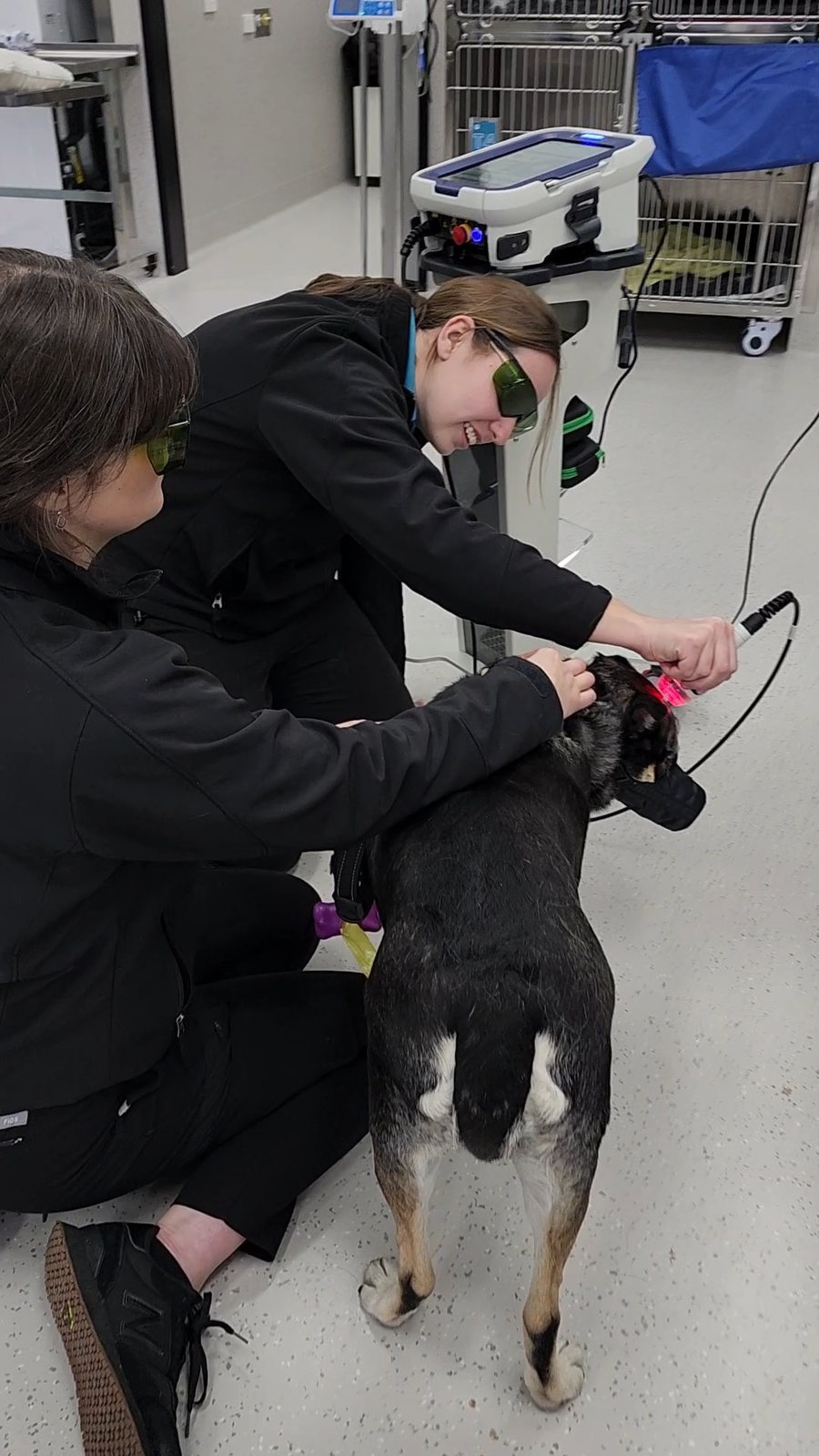
Most dogs get themselves up without help after TPLO surgery, even big ones. Where owners run into trouble is with very large, very heavy dogs in the first few days, and with the temptation to lift them the wrong way.
Moving and supporting a large dog after surgery
To help your dog stand, slide a towel under their belly and lift gently as they get up. This supports their weight without you taking all of it, and it protects your back as well as their leg. A commercial sling does the same job if you would rather buy one.
If your dog cannot get up by themselves at all, let us know. That can happen in very big, very heavy dogs, and some of them will not put weight on the operated knee at first. I would rather hear from you early than have you struggling at home.
Preventing slips and falls on hard floors
A fall in the first few weeks can bend the plate or loosen a screw, which puts you back at square one. That risk matters more in large dogs, which is why we are firm about flooring.
Keep your dog on carpet where you can. On tiles or floorboards, lay down non slip runners or mats. Bunnings, Amazon, and eBay all stock them cheaply, and they make an immediate difference.
Some owners also use grip socks or booties, which slide over the paws. I have not had much experience with those myself. What I do know works is non slip mats and carpet, so that is where I would start.
Worth remembering: the slip risk does not disappear after the strict rest period. Weeks five and six, when your dog is moving more and feeling confident, are exactly when a slip is likely.
When can a large dog start physiotherapy after TPLO surgery?
Physiotherapy can start the day after surgery, and the sooner the better.
The reason is that a dog who avoids using the leg develops tight muscles and tendons. That tightness then causes its own soreness, and it becomes hard to tell whether a limp is coming from the surgery or from stiffness. Early, gentle rehab prevents that confusion and prevents muscle wasting.
The goal of physiotherapy at every stage is the same: keep the muscles working, prevent atrophy, and get your dog back to normal function without loading the leg too early.
What exercises can you do at home in the first week?
Gentle massage can start the day after surgery. From around day three, add passive range of motion: hold your dog’s leg, slowly bend the knee, then slowly extend it. Repeat about 10 to 20 times, three times a day.
Never force it. In these early stages, whatever small movement your dog will allow is enough. If they resist, stop and try again later.
With the massage, work on the thigh muscles and the muscles around the surgical site, which are the ones that tend to tighten up.
You do not have to guess at any of this. Our post-knee surgery physiotherapy page has a full weekly breakdown of the exercises, when to do them, and videos showing exactly how. Go have a look before your dog comes home so you are ready.
Professional canine physiotherapy and hydrotherapy options
Wait until the skin incision has healed, which is around two weeks. That timing is deliberate. Once the incision has sealed there is no risk of water seeping into the wound and causing an infection.
Wherever you go, make sure the therapist is qualified and understands what a TPLO involves and what the recovery requires. It makes a real difference to how the sessions are structured.
The Melbourne facilities we refer to are Aquapaws, Animalia Physiotherapy, and Dogs in Motion. A typical session is supervised, structured exercise on an underwater treadmill, guided by a therapist who knows TPLO recovery. Dogs in Motion note that controlling water depth, speed and temperature lets them tailor the work to each dog, and that benefits can come from as little as one to two sessions a week.
What medications does a large dog need after TPLO surgery?
Pain relief starts before your dog wakes up. During surgery they receive a local nerve block plus a splash block of lignocaine and bupivacaine, which covers roughly the first 12 hours.
They then go home on two things:
- An anti inflammatory (NSAID). This reduces inflammation, and by reducing inflammation it provides pain relief.
- An opioid, usually a fentanyl patch applied to the leg. The patch releases fentanyl through the skin into the bloodstream for about three to four days, which covers the most painful part of the recovery. Most dogs do not need any further opioid pain relief after that.
Paracetamol can be added at home if you feel your dog needs a bit more. Call us first. We will confirm a dose that is right and safe for your dog, and it should never be given without that advice.
Long term joint care and arthritis management after TPLO
Every dog who has had a cruciate injury will develop some degree of arthritis. That is worth saying plainly, because owners are often surprised by it.
Here is why. Once the cruciate ligament is damaged, the joint is no longer moving the way nature intended. The bone reacts by laying down extra bone to try to stabilise the joint, the cartilage wears down, and eventually you get bone on bone contact. Opening the joint surgically adds to that. The point of a TPLO is not to prevent arthritis altogether. It is to stop the pain and slow the arthritis down significantly.
Long term management comes down to three things:
- Diet. Keeping your dog lean is the single most effective thing you can do for their joints. We can recommend a diet that supports a healthy weight and provides omega 3 and omega 6 fatty acids in the right ratio.
- Pentosan polysulfate injections (Zydax). This is a disease modifying osteoarthritis drug. It reduces inflammation in the joint and encourages cartilage to grow. The course is one injection a week for four weeks, then repeated every four to six months.
- Anti inflammatories as needed. Every dog has a day where they overdo it and do zoomies. Having anti inflammatories at home means you can cover a two or three day flare up without waiting for an appointment.
How do you know when your dog has fully recovered from TPLO?
The only way to confirm it properly is with x-rays. Once we have taken them at week 8, 10, or 12 and the surgeons have reviewed them, we let you know, and your dog can go back to off lead running and normal life.
In most uncomplicated cases, by 12 weeks with no lameness at all, we can reasonably assume the bone has healed, because that is how long healing takes. But we cannot be certain without the images, and given what is at stake we would rather be certain.
Signs your large dog’s recovery is on track
- By week 2: your dog is putting weight on the operated leg.
- Throughout: no redness, no oozing, no heat, and no swelling around the incision.
- By weeks 3 to 4: little to no lameness in that leg.
- By weeks 10 to 12: no limp at all, and your only real problem is keeping them rested enough.
We stay in touch through the early weeks anyway, because you will be coming in weekly for the Zydax injections up to about week four. That gives us regular eyes on the leg and a chance to tell you whether things are tracking well.
After that there is a gap of a few weeks where we do not see you. If something changes in that window, for example your dog gets onto the couch and is limping afterwards, do not wait for the eight week appointment. Bring them in.
Talk to us about your dog’s TPLO recovery
A TPLO is a big surgery, and the recovery asks a lot of you as well as your dog. The good news is that large dogs do very well with it. Once the bone has healed in its new position, they run, play, and get on with life.
If your dog is booked in for cruciate surgery, or you are partway through recovery and something does not look right, give us a call or book online. We would rather answer a question early than fix a problem later.
Frequently asked questions about TPLO recovery in large dogs
How long does TPLO recovery take in dogs?
Most dogs take about 10 to 12 weeks to fully recover from TPLO surgery, which is the time the bone needs to heal in its new position. Many are walking comfortably much earlier, but a full return to off lead exercise usually comes after x-rays at around 8 to 12 weeks confirm healing.
Can large dogs fully recover from TPLO surgery?
Yes. TPLO works by changing the angle of the top of the shin bone so the cruciate ligament is no longer needed to stabilise the knee. Once the bone has healed in its new position and there are no complications, large dogs can run, play and return to normal activity.
What happens if a dog is too active too soon after TPLO surgery?
Too much activity too early causes pain and can damage the implants. Powerful muscles in a large dog can bend the plate, crack a screw or loosen one, disrupting the bone cut. That means more pain and usually revision surgery, which is harder and less predictable than the first operation.
Is swelling normal after TPLO surgery?
Some swelling is normal. The ankle on the operated leg often swells as fluid drains down, and this settles over two to three weeks. Mild swelling at the incision for a day is expected. Swelling that is red, hot, painful or getting worse after two to three days is not normal.
When can my dog walk without a limp after TPLO surgery?
Most dogs start putting weight on the leg by the end of week one and improve further through week two. By weeks three to four there is usually little to no visible limp. Timing varies between dogs, but by the final arthritis injection most are walking without a noticeable limp.