
Scenario: You’re overwhelmed with excitement as it’s finally the day you’re bringing your new family member to the vet for their very first health check. Your veterinarian invites you into the consultation room and, after smothering your delighted fur baby with many cuddles and kisses, they begin the clinical examination, only to find that your new puppy or kitten has a heart murmur. Your instant thought is that this must mean bad news, but it’s not always the case.
So, what is a heart murmur, and what does it mean?
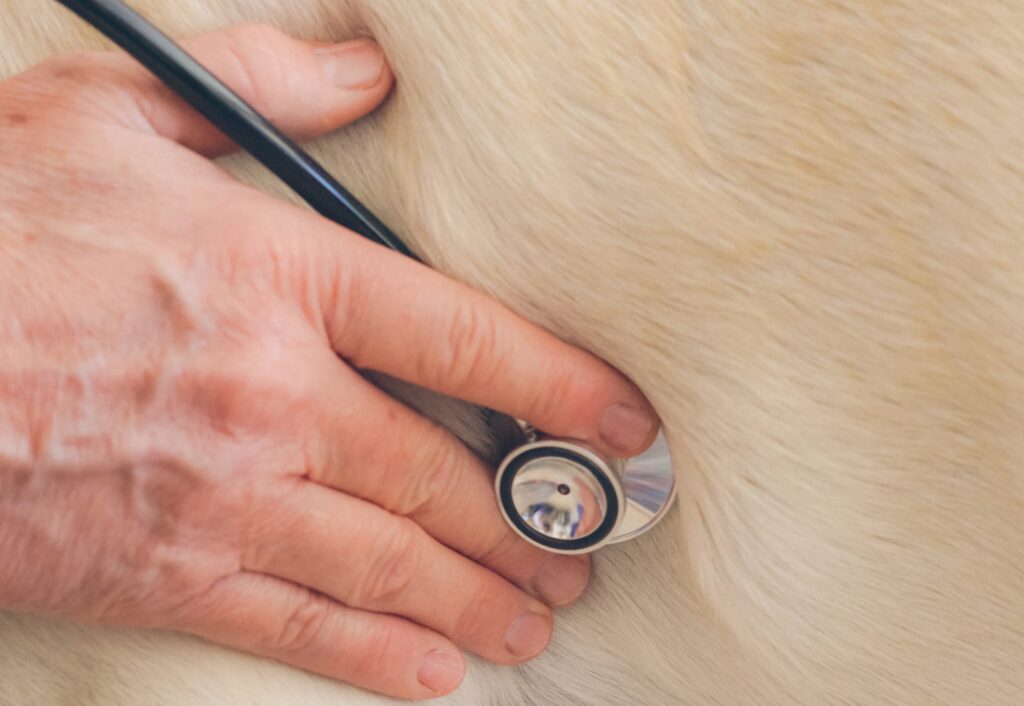
A heart murmur is a medical term that describes an abnormal heart sound. When we listen to a heart with a stethoscope, we are looking to hear a classic rhythmic “lub” and “dub” sound.
A heart murmur is similar to a “whoosh” or “shhh” sound and reflects blood moving at a faster-than-normal rate or with turbulent flow within the heart chambers.
A detection of a heart murmur does not necessarily confirm a diagnosis of heart disease, but it could allude to blood flowing abnormally within the heart for a number of reasons.
Congenital defects:
Pathological heart murmurs are associated with cardiac disease, and when present in young puppies and kittens, are most likely thought to be a congenital condition or abnormality within the heart that they have been born with. This includes conditions such as:
- heart valve defects (dysplasia),
- holes within the heart (septal defects),
- narrowing of heart valves (stenosis)
- or abnormal blood vessel connections (patent ductus arteriosus).
When present, these murmurs tend to be very loud or have a high intensity when listened to with a stethoscope.
Your new puppy and kitten may also be more tired or sleep more than normal, be unwilling to exercise or play, not be growing as expected or may even experience breathing difficulties when exerting themselves.
If there is suspicion that your puppy or kitten has a pathological heart murmur, it is important to act as soon as possible to determine the underlying cause. However, these conditions are rare or uncommon, and, in most cases, it is more likely that your puppy or kitten has what we call a physiological or ‘innocent’ murmur.
Temporary murmurs:
Physiological murmurs are not associated with underlying heart disease or defects and are quite common in puppies and kittens, especially during periods of rapid growth. They are often described as low-grade or having low intensity and can also be intermittent, not always present. Your puppy and kitten will also be otherwise acting completely normally.
These murmurs often disappear on their own after 4-6 months of age and cause no concern to your pet’s overall health. In this situation, your veterinarian will often monitor your pet’s heart over this period to ensure the murmur is resolving on its own.
When to take action
It is important to consider when to take further action so that we can appropriately investigate or diagnose the cause of your new puppy or kitten’s heart murmur.
Further investigation is recommended if we / you see any of the following in your puppy or kitten:
- Has a continuous, loud, or high-intensity heart murmur
- Is more tired and sleeping more than normal.
- Is experiencing breathing difficulties at rest or during exercise.
- Is not growing or hitting growth targets as expected.
- Has a physiological or low-grade murmur that persists after 4-6 months of age.

How do we investigate, and what are the expected outcomes?
- Blood test: To further investigate your puppy and kitten’s heart murmur, we can first run a blood test called a canine/feline cardiac proBNP test. This tests for the protein BNP, which can leak into the blood when the heart is significantly diseased or under stress. At Berwick Clyde and Lynbrook Vet, we can perform this test through our in-clinic laboratory, and results are available on the same day. If the proBNP results return positive or abnormal, then it is strongly recommended that your puppy and kitten have an ultrasound of their heart.
- Echocardiogram: An ultrasound of the heart is called an echocardiogram, and it can be booked either via referral to a veterinary cardiologist (heart specialist) or performed by a specialist ultrasonographer who comes into our clinic for the day to perform the ultrasound.
This ultrasound is the most accurate way of determining if there are abnormalities or defects in the heart that could be causing your puppy or kitten’s heart murmur. Once a diagnosis is made, we can then look at organising the recommended treatment for your puppy or kitten.
Based on the heart ultrasound results, most cats and dogs with heart murmurs require repeat ultrasounds every 6-12 months to monitor their heart disease if detected. The ultrasound will also be able to determine if your puppy or kitten has a physiological murmur, and if this is the case, no further action is required, and this will not impact your pet’s health long term.
In summation, it is important that your puppy or kitten undergo several health checks during their first year of life.
We normally see them between 8-10 weeks, then again for their desexing (where applicable) at 6 months, and then again for their juvenile health check at 9 months.
During these checks, we listen to the heart and discuss any abnormalities with you. If we discover a heart murmur, we will recommend that the appropriate tests be done ASAP.
Remember, a heart murmur does not always mean a congenital defect in your puppy or kitten. However, a quick investigation and diagnosis will give your puppy/kitten the very best chance at a normal life and provide you with peace of mind.
Call our supportive team to discuss your pet’s needs, or book an appointment here.