Gastropexy Surgery
Gastropexy is a preventative surgery designed to improve your dog’s quality of life if they are at risk of GDV, commonly known as ‘bloat.’ As with any procedure, it’s important to be well-informed, and we’ve provided everything you need to know below. Our veterinarians have extensive experience with GDV and gastropexy, and we’re here to answer any additional questions or provide a consultation. Your pet’s health and well-being are our priority, and we’re always happy to help.
What is Gastropexy?
Gastropexy is a prophylactic surgery commonly performed in large to giant breed dogs that are predisposed to developing a condition called gastric dilatation volvulus (GDV) or “bloat”.
Why is Gastropexy Surgery Performed?
The two main reasons this surgery is performed are to prevent the occurrence of gastric dilatation volvulus and to reduce the risk of recurrence in dogs diagnosed with gastric dilatation volution. This procedure can also be performed for treatment of other conditions such as a hiatal hernia.
Gastropexy involves the creation of a permanent adhesion between the stomach and the adjacent body wall. The appropriate timing of the surgery is yet to be determined, but multiple studies have reported a decreased mortality rate associated with dogs that have undergone prophylactic gastropexy. The recurrence rate of GDV is reported to be 55% in dogs that do not undergo a prophylactic gastropexy compared to 4% in dogs where a gastropexy is performed.
What is Gastric Dilatation and Volvulus (GDV)?
Gastric dilatation volvulus, or GDV, is a life-threatening condition that occurs when the stomach dilates with an abnormal amount of air and rotates on its axis, causing it to twist in a clockwise direction. Rotation can result in a maximum 270o torsion of the stomach. As the stomach wall rotates, it can start to compromise blood flow to the stomach and other organs in the body.
The pressure of the dilated stomach within the abdomen can also reduce the amount of blood able to return to the heart, leading to poor blood circulation and low blood pressure. Without appropriate medical and surgical emergency stabilisation, this condition can become fatal. Mortality rates in general, have been reported between 15-20%.

From Slatter DH, editor: Textbook of small animal surgery, ed 3, St Louis, 2003, Saunders/Elsevier.
What Dog Breeds Are Prone to Developing GDV?
There are many deep-chested and large dog breeds that are at high risk of developing GDV, such as Great Danes, Gordon Setters, Irish Setters, Weimaraners, Saint Bernards, Standard Poodles and Bassett hounds. The lifetime risk for these breeds predisposed to the development of gastric dilatation volvulus is reported to be between 4% and 37%.
What Are the Risk Factors Associated With the Development of GDV?
Risk factors include increased chest depth-to-width ratio, history of GDV in a first-line relative, feeding fewer meals in a day, eating rapidly, aggressive or anxious temperament, decreased food particle size and exercise or stressful events after meals.
However, it is important to note that gastric dilatation volvulus can still affect any dog breed of any age and size.
What Are the Clinical Signs of GDV?
- Unproductive vomiting or retching.
- Restlessness, shaking, unable to sit down.
- Hypersalivation.
- Pale gum colour.
- Low or high heart rate.
- Weak pulses.
- Enlarged or abnormally distended stomach.
- Cold extremities.
- Dull mentation.
How is Gastropexy Performed?
There are a variety of surgical techniques used to perform a gastropexy. At Berwick Clyde Vet, we perform a technique called an incisional gastropexy.
An incisional gastropexy is performed by making a midline incision into your dog’s abdomen to allow access to the stomach and inside of the abdominal wall. Once the stomach has been identified, a 4-5 cm incision is created in the muscular layer of the stomach wall in a region of the stomach called the pyloric antrum.
A second incision is then made on the right-hand side of the abdominal wall through the transverse abdominal muscle just behind the last rib.
The stomach and abdominal wall are then joined or sutured together at the opposing incision sites. This results in the stomach being tacked or anchored to the abdominal wall to prevent it from rotating whilst keeping it in the correct anatomical position for normal functioning of the stomach to still occur.
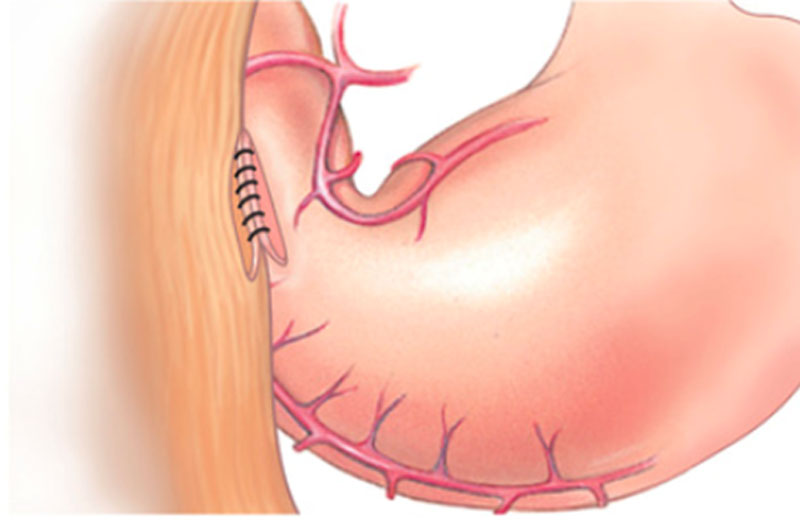
Drawings from Fossum T, editor: Small animal surgery, ed 3, St Louis, 2002, Mosby/Elsevier.)
What is Involved in the Recovery Period?
The recovery period is no different to a routine desexing procedure. It is recommended that your dog is kept rested with restricted exercise for 10-14 days post-surgery to allow the incision to heal appropriately.
Short-leashed walks to the toilet are allowed, but avoidance of strenuous exercise is strongly recommended. This includes limited playtime, running, jumping and normal exercises such as walks around the neighbourhood and park.
Your dog will be sent home with pain-relief to help them keep comfortable in the post-operative period. We advise that the wound is checked daily for any redness, swelling or abnormal discharge.
If there are any concerns with the wound it is important to contact the clinic and book an appointment for us to assess the wound. Your dog will also be sent home with an Elizabethan collar to be worn around the neck to prevent licking and self-traumatisation of the wound.
At the end of the 10 to 14-day period, a post-operative appointment will be booked to allow your veterinarian or nurse to perform a health check and wound assessment of your pet before they are allowed to return to normal activity levels and have their Elizabethan collar removed.
Why Choose Us?
At Berwick Clyde Vet, we have extensive experience in performing gastropexy surgeries and care for your pets as if they were our own. Our commitment to you and your pet doesn’t end when you leave our clinic—we’re here to support you every step of the way until your pet is fully recovered. If you’d like to learn more about gastropexy surgery and how it can benefit your pet, our friendly team is always here to help.